Kia Optima DL3: Evaporative Emission Control System / Purge Control Solenoid Valve (PCSV)
Specifications
| Specification |
|
Item |
Specification |
|
Coil Resistance (Ω) |
22.0 - 26.0 [20°C (68°F)] |
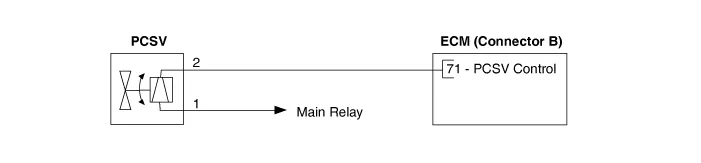
Schematic diagrams
| Circuit Diagram |
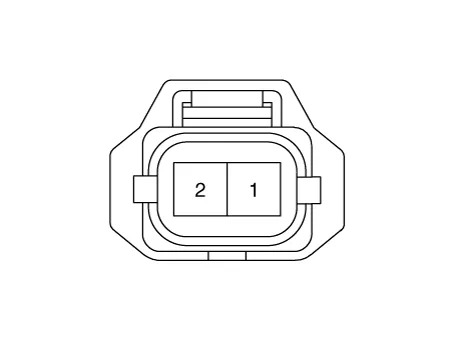
Harness Connector
Repair procedures
| Inspection |
| 1. |
Turn the ignition switch OFF. |
| 2. |
Disconnect the PCSV connector. |
| 3. |
Measure resistance between the PCSV terminals 1 and 2. |
| 4. |
Check that the resistance is within the specification.
|
| Removal |
| 1. |
Disconnect the negative battery (-) terminal. |
| 2. |
Remove the air cleaner. (Refer to Engine Mechanical System - "Air Cleaner") |
| 3. |
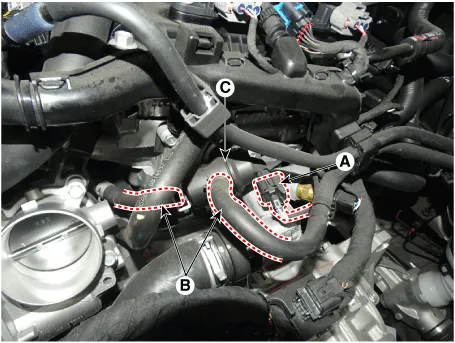
Disconnect the purge control solenoid valve connector (A). |
| 4. |
Disconnect the vapor hoses (B) from the purge control solenoid valve. |
| 5. |
Remove the valve (C) from the surge tank after pulling it.
|
| Installation |
| 1. |
Install in the reverse order of removal.
|

Repair procedures Removal 1. Disconnect the negative battery (-) terminal. 2. Remove the [LH] rear wheel guard.
Description and operation Description Exhaust emissions (CO, HC, NOx) are controlled by a combination of engine modifications and the addition of special control components.
Other information:
Kia Optima DL3 2019-2026 Service and Repair Manual: Evaporator Temperature Sensor
Description and operation Description The evaporator temperature sensor will detect the evaporator core temperature and interrupt compressor relay power in order to prevent evaporator from freezing by excessive cooling. The evaporator temperature sensor has the Negative Temperature Coefficient (NTC).
Kia Optima DL3 2019-2026 Service and Repair Manual: In-car Sensor
Description and operation Description The In-car air temperature sensor is built in the heater & A/C control unit. The sensor contains a thermistor which measures the temperature of the inside. The signal decided by the resistance value which changes in accordance with perceived inside temperature, is delivered to heater co
Categories
- Manuals Home
- Kia Optima Owners Manual
- Kia Optima Service Manual
- Restraint
- Body Electrical System
- Suspension System
- New on site
- Most important about car
