Kia Optima DL3: Rear Suspension System / Trailing Arm
Repair procedures
| Removal |
| 1. |
Disconnect the (-) battery terminal. |
| 2. |
Remove the rear wheel and tire. (Refer to Tires/Wheels - "Wheel") |
| 3. |
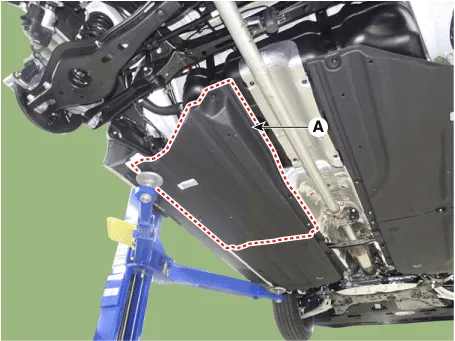
Remove the under cover (A).
|
| 4. |
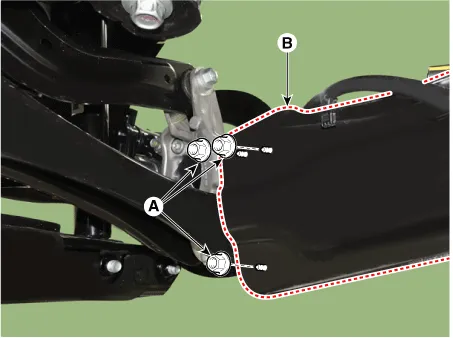
Loosen the nut (A) and remove trailing arm (B) from rear axle.
|
| 5. |
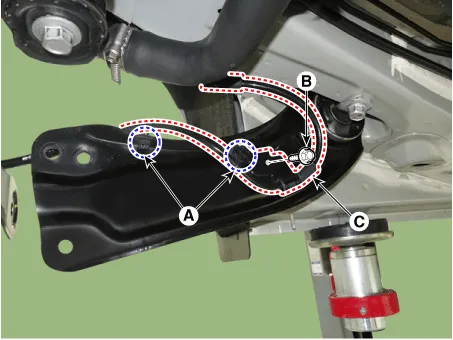
Loosen the fastener (A) and the bracket mounting bolt (B) and remove the rear wheel speed sensor line (C) from the trailing arm.
|
| 6. |
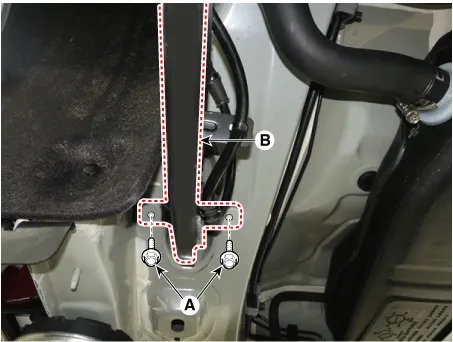
Loosen the mounting bolt (A) and remove the trailing arm (B).
|
| Inspection |
| 1. |
Check the bushing for wear and deterioration. |
| 2. |
Check the trailing arm for deformation. |
| 3. |
Check for all bolts and nuts. |
| Installation |
| 1. |
Install in the reverse order of removal. |
| 2. |
Check the alignment. (Refer to Suspension System - "Alingment") |
Repair procedures Removal 1. Disconnect the (-) battery terminal. 2. Remove the rear wheel and tire.
Repair procedures Removal 1. Disconnect the (-) battery terminal. 2. Loosen the bolt and nut (A) and then disconnect the rear stabilizer link from the rear lower arm.
Other information:
Kia Optima DL3 2019-2026 Service and Repair Manual: Power Door Mirror Switch
Schematic diagrams Connector and Terminal Function Pin Function 1 B-CAN (Low) 2 B-CAN (High) 3 Ground (Assist safety) 4 Assist safety 5 LIN (For IMS)
Kia Optima DL3 2019-2026 Service and Repair Manual: Power Window Switch
Schematic diagrams Connector and Terminal Function Power Window Main Switch Pin Function 1 B-CAN (Low) 2 B-CAN (High) 3 Ground (Assist safety) 4 Assist safety 5
Categories
- Manuals Home
- Kia Optima Owners Manual
- Kia Optima Service Manual
- Air bag collision sensors
- Restraint
- Engine Control / Fuel System
- New on site
- Most important about car
