Kia Optima DL3: Power Train / Battery
Repair procedures
| Inspection |
| [NU 2.0 MPI] |
Battery Voltage and Status
Check the battery voltage and status by using a battery tester.
Battery Terminal
| 1. |
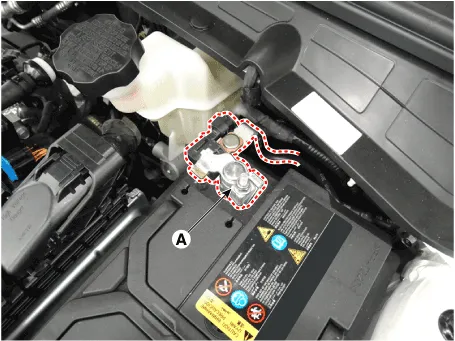
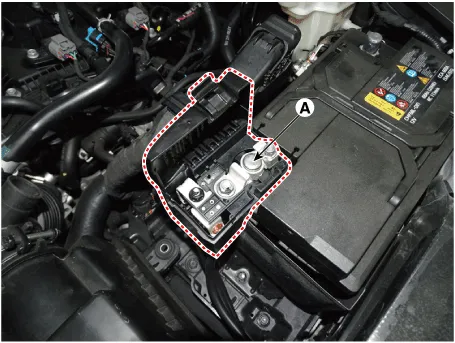
Move back and forth to check if the battery terminals (A) are loose or corroded. Clean any corroded terminals.
If the battery positive connection is loose, disconnect the ground (GND) cable first before attempting to remove or tighten the positive connection to prevent personal injury. |
| 2. |
If the battery clamp on positive (+) battery terminal is not seated securely:
|
| 3. |
If the battery clamp on negative (-) battery terminal is not seated securely:
|
| [THETAⅢ 2.5 GDI] |
Battery Voltage and Status
Check the battery voltage and status by using a battery tester.
Battery Terminal
| 1. |
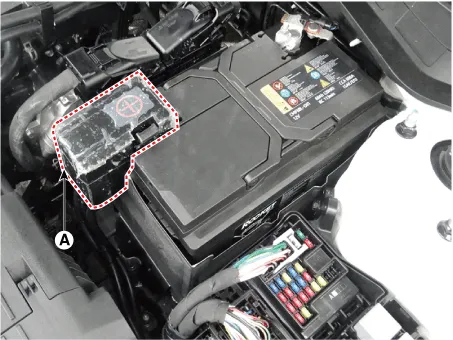
Move back and forth to check if the battery terminals (A) are loose or corroded. Clean any corroded terminals.
If the battery positive connection is loose, disconnect the ground (GND) cable first before attempting to remove or tighten the positive connection to prevent personal injury. |

| 2. |
If the battery clamp on positive (+) battery terminal is not seated securely:
|
| 3. |
If the battery clamp on negative (-) battery terminal is not seated securely:
|
Repair procedures Inspection 1. Remove the air cleaner element. 2. Check if the air filter is excessively dirty.
Repair procedures Inspection Radiator hoses 1. Check radiator hoses for the following: (1) Improper attachment (2) Leaks (3) Cracks (4) Damage (5) Loose connections (6) Chafing (7) Deterioration Coolant level 1.
Other information:
Kia Optima DL3 2019-2026 Service and Repair Manual: Relaxion Comfort Seat
Components and components location Component Location 1. Relaxion comfort switch 2. Walk-in switch 3. Relaxion comfort seat unit (RCSU) Schematic diagrams Connector and Terminal Function Pin Function Connector A Co
Kia Optima DL3 2019-2026 Service and Repair Manual: Smart Key Diagnostic
Repair procedures Inspection 1. In the body electrical system, failure can be quickly diagnosed by using the vehicle diagnostic system (KDS). The diagnostic system (KDS) provides the following information. (1) Self diagnosis : Checking failure and code number (DTC).
Categories
- Manuals Home
- Kia Optima Owners Manual
- Kia Optima Service Manual
- Lift And Support Points
- Motor Driven Power Steering
- Brake System
- New on site
- Most important about car
